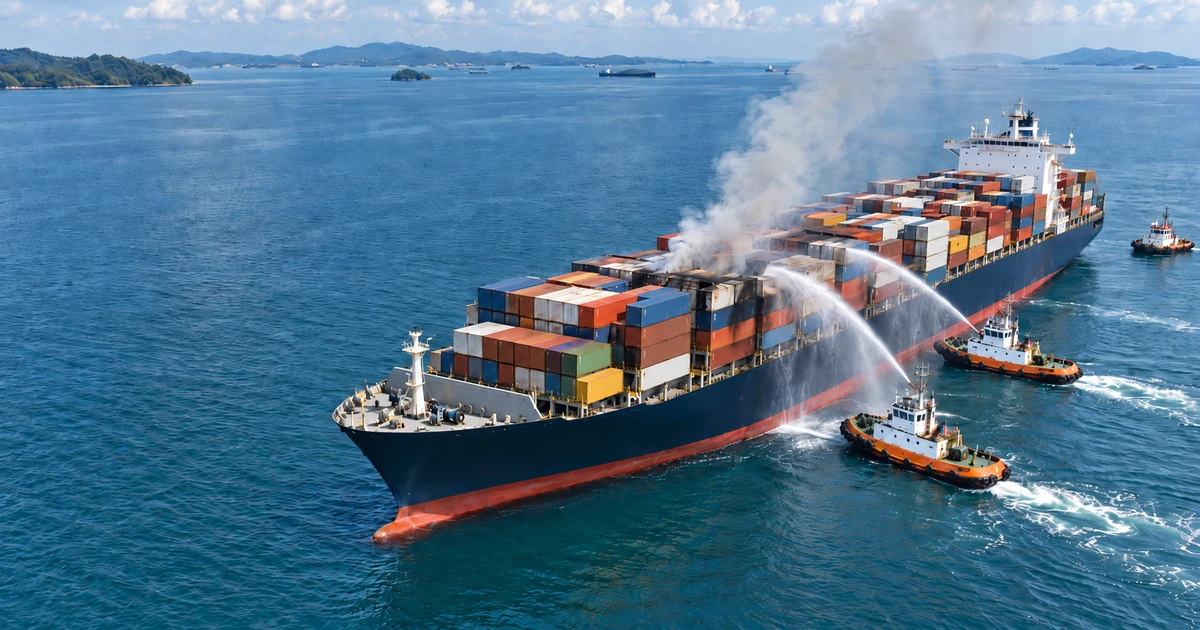
- CMA CGM has declared general average on the container ship CMA CGM Petra after a cargo hold fire in the Strait of Malacca in August 2026. This means every cargo owner with goods on board must provide security before their cargo is released, even if their goods were not damaged.
The vessel was carrying cargo loaded in Qingdao and Nansha (Guangzhou), including containers handled by Kankei. This article explains what happened, what general average means, and what cargo owners need to do next.
What happened to CMA CGM Petra
CMA CGM Petra is a French-flagged, LNG-fuelled container ship of about 8,000 TEU (twenty-foot equivalent units, the standard measure of container capacity). She was delivered in 2024 and sails on CMA CGM’s KILIMA service between Asia and East Africa. On this voyage (0K13NW1MA) she loaded cargo in Qingdao and Nansha before the fire.
| Date (2026) | Event |
|---|---|
| Mid-September | CMA CGM declares general average and appoints Albatross Adjusters |
| 11 September | Vessel berths at Port Klang, Malaysia; about 450 containers are discharged for inspection |
| 9 September | CMA CGM advises that the fire is under control |
| 25 August | CMA CGM confirms professional salvors are engaged; no crew injuries or pollution |
| 22–23 August | Crew find a fire in a cargo hold in the Strait of Malacca (dates differ by time zone) |
| 13 August | Vessel calls at Nansha, Guangzhou |
The crew first contained the fire. Salvors from SMIT then took over firefighting while the ship stayed near Penang, and CMA CGM signed a Lloyd’s standard salvage agreement. A fire expert is investigating the cause, which has not yet been published.
What is general average?
General average (GA) is an old rule of maritime law. When extraordinary costs or sacrifices are made to save a ship and its cargo from a common danger, everyone with an interest in the voyage shares those costs. That includes the shipowner and every cargo owner on board.
In the Petra case, the costs include firefighting, salvage, towing and the discharge and inspection of cargo at Port Klang. Most GA cases today follow the York-Antwerp Rules, an international set of rules on how these costs are shared.
Three points often surprise cargo owners:
- Undamaged cargo still contributes. Your goods may be in perfect condition, but they were saved by the same effort, so they share the cost.
- Your share depends on cargo value. Each owner pays in proportion to the value of their goods, compared with the total value of the ship and all cargo saved.
- The final figure comes much later. A professional average adjuster calculates the final shares. This can take months or years, so carriers ask for security first and settle later.
What cargo owners need to do
The carrier will not release cargo until the adjusters accept GA security for it. For most cargo owners this means:
- Sign a general average bond. This is a signed promise to pay your final share once the adjustment is complete.
- Provide a guarantee or a cash deposit. If your cargo is insured, your insurer can issue a GA guarantee, and you usually pay nothing upfront. If it is not insured, you pay a cash deposit, set by the adjusters as a percentage of your cargo value.
- Send proof of cargo value. Usually the commercial invoice. The adjusters use it to work out your share.
Because a Lloyd’s salvage agreement was signed, the salvors may also ask for separate salvage security. Your forwarder will confirm exactly what is required for your shipment. Acting quickly matters: delays in providing security can delay release and add storage costs.
How general average works for LCL shipments
LCL (less than container load) means your goods share a container with goods from other shippers. The container moves under one master bill of lading (MBL) from the shipping line, while each customer has their own house bill of lading (HBL) from the forwarder.
In a GA case, the adjusters still look at the value of each customer’s goods. So each HBL owner provides security for their own cargo, based on their own commercial invoice. The forwarder acts as the link: it deals with the carrier and adjusters on the MBL, collects each customer’s documents and security, and arranges release of the whole container once everything is in place.
This is why one customer’s delay can hold up the release of a shared container. If you have LCL cargo on this vessel, sending your documents early helps every customer in the box.
Does cargo insurance help?
Yes, but it does not make the GA share disappear. Every cargo owner on board has to contribute. The difference is how you provide security. With marine cargo insurance, your insurer gives the guarantee and handles the final payment under your policy. Without it, you pay a cash deposit yourself and carry the final cost.
Cargo insurance is arranged by the goods owner, either directly with a licensed insurer or through the supplier under the agreed Incoterms (for example, CIF terms, where the seller arranges insurance). As a freight forwarder, Kankei is not licensed to sell insurance and does not offer it.
We recommend that every importer speaks to a licensed marine insurer before their next shipment. GA cases are rare, but when they happen, insured owners get their cargo released faster and with far less cash upfront.
How Kankei is handling the case
Kankei has cargo on board CMA CGM Petra, including an LCL consolidation shared by several customers. We are in contact with the carrier and the adjusters, and we are updating each affected customer directly with the documents and steps that apply to their shipment.
If you have cargo on this vessel and are unsure whether your shipment is affected, contact your forwarder with your bill of lading number.
Frequently asked questions
Was my cargo damaged in the CMA CGM Petra fire?
Not necessarily. A GA declaration applies to all cargo on board, not only damaged cargo. About 450 containers were discharged at Port Klang for inspection. Your forwarder or the carrier can confirm the status of your container.
Why do I have to pay if my goods are fine?
Under general average, the costs of saving the ship and cargo are shared by everyone whose property was saved. Undamaged cargo benefited from the same firefighting and salvage work.
How much will I pay?
The adjusters set a deposit rate as a percentage of cargo value. The final amount is only known when the adjustment is finished, and any excess deposit is refunded.
Can I refuse to provide GA security?
The carrier can hold cargo until acceptable security is provided. Refusing usually means your goods are not released.
Who is the average adjuster for CMA CGM Petra?
CMA CGM has appointed Albatross Adjusters.
Will this delay my cargo?
Yes. Inspection, GA security and onward shipping all add time. Your forwarder will share updated arrival dates as they are confirmed.